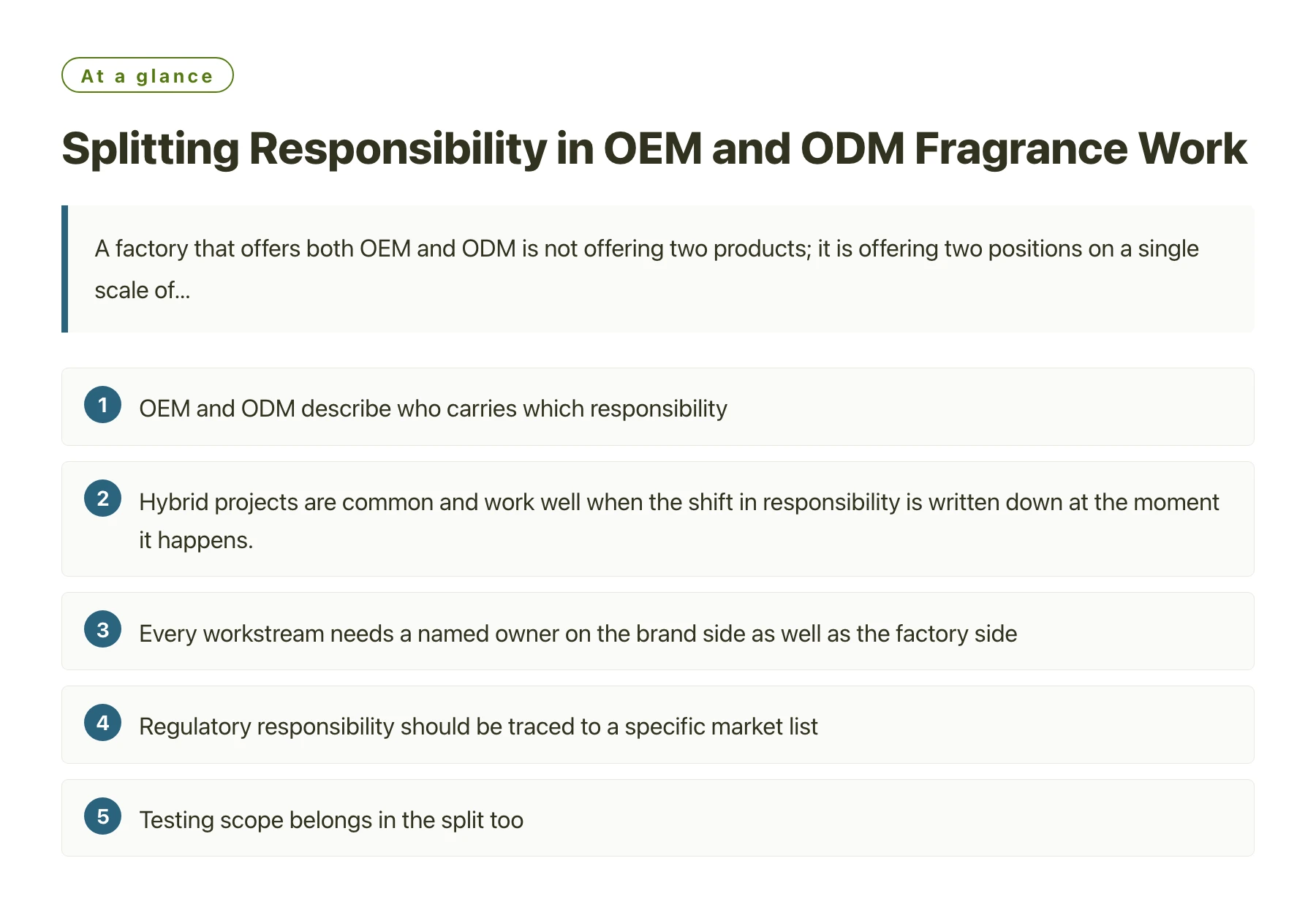
A factory that offers both OEM and ODM is not offering two products; it is offering two positions on a single scale of responsibility. The trouble starts when a project moves along that scale without anyone saying so, and the brand discovers at the bulk stage that it has been buying a development service while believing it bought a production service. The fix is a written split, agreed workstream by workstream.
Key takeaways
- OEM and ODM describe who carries which responsibility, so the useful document is a workstream split rather than a mode label.
- Hybrid projects are common and work well when the shift in responsibility is written down at the moment it happens.
- Every workstream needs a named owner on the brand side as well as the factory side, because shared ownership becomes no ownership very quickly.
- Regulatory responsibility should be traced to a specific market list, since the supplier cannot answer for markets it was never told about.
- Testing scope belongs in the split too, because an unstated test is a test nobody has budgeted for.
Most fragrance suppliers describe themselves as offering OEM and ODM side by side, and most brands accept the phrasing without asking where the boundary sits. The boundary is real, but it is not the same from one project to the next, and it moves.
A project can begin with the factory proposing directions, shift to the brand specifying revisions, and end with the brand owning a formula that was largely developed in-house. Nothing about the contract changed along the way, which is exactly how disputes are born.
The practical answer is to stop arguing about labels and to draw a table: workstream, who owns the decision, who does the work, and what evidence proves it was done. That table is short, and it is the document worth revisiting whenever scope shifts.
Why the line moves during a project
Responsibility drifts for ordinary reasons. A brand sees a direction it likes and starts giving detailed technical instruction, which is OEM behaviour. A factory offers a proven base and the brand accepts most of it, which is ODM behaviour. Neither move is a problem on its own.
The problem appears later, when one side points to the label and the other points to what actually happened. Price, timeline and ownership all follow the responsibility split, so the split has to be recorded rather than assumed.
The three things that actually shift
Only three elements move when a project slides between modes: who authors the direction, who owns the resulting formula, and who absorbs the cost of a failed round. Everything else, including filling, packing and logistics, is usually a separate commercial question.
Naming those three explicitly at the start makes later conversations much shorter, because each one has a natural moment when it becomes concrete: at the first sample, at the formula lock, and at the first rejected round.
Why hybrid arrangements are normal
Pure OEM and pure ODM are rare in practice. Most brands want the factory to bring a starting point and then expect tight control over the final iterations, which is a sensible way to buy development without paying for it twice.
The arrangement works as long as both sides agree that it is hybrid. It fails when the brand believes the factory owns the outcome while the factory believes it is executing instructions.
The cost of an unrecorded shift
When the split is unclear, revision rounds multiply, because nobody can tell a correction from a new request. The factory quotes additional rounds as new work, the brand considers them part of the original brief, and the launch date absorbs the delay.
Recording the split costs a meeting. Recovering from an unclear split costs weeks.
Drawing the split on one page
- List the workstreams before pricing themDevelopment, formula ownership, documentation, testing, artwork, tooling, filling and logistics should each appear as a line.
- Name an owner on both sidesEvery line needs a person at the factory and a person at the brand, because an unowned line is where delays accumulate.
- Mark the decision rights, not just the tasksSay who approves, who is consulted and who is merely informed, then check that the approver can realistically respond in time.
- Attach a market list to the documentation lineWrite the countries the product will be sold in, since regulatory support only covers markets the factory has been told about.
- Agree what a revision isDefine the size of change that counts as a new round so both sides can see when extra charges begin.
- Review the page when scope changesReopen it at the formula lock and before the bulk order, when shifts in responsibility are most likely to have happened quietly.
The clause that causes the most trouble is the one nobody reads twice: what happens to the formula if the relationship ends. Ask three questions and write the answers down. Who holds the formula, may it be supplied to anyone else in the same market, and what documentation transfers if the brand leaves. A supplier that answers these without hesitation is describing a process it already runs; one that has to invent an answer is describing a process it does not. A factory that runs both modes from one site, as Xuelei does, should be able to answer all three without checking.
The split, workstream by workstream
| Workstream | Typical OEM position | Typical ODM position | What belongs in the agreement |
|---|---|---|---|
| Starting direction | Brand supplies the brief or the formula | Factory proposes from existing work | Who approves the direction and by when |
| Formula ownership | Often the brand, if drafted that way | Often the factory, licensed to the brand | Ownership, exclusivity scope and duration |
| Regulatory documents | Issued for the markets named in the brief | Often included for the factory's usual markets | A named market list and a delivery milestone |
| Testing | Agreed case by case and usually charged | Frequently part of the standard development package | Which tests, who pays, and what counts as a pass |
| Tooling and artwork | Usually brand-owned | Sometimes shared or factory-owned | Who holds the moulds and the source files |
| Exit | Documentation handover is negotiable | Licence terms usually continue | What transfers, in what format, at what cost |
The middle two columns are tendencies rather than rules, which is precisely why the fourth column exists. Responsibility in this industry follows the paperwork, not the brochure, and the paperwork is written in a few hours by people who will not be present when the disagreement happens.
Where responsibility gets blurred in practice
Even with a written split, three areas blur more often than the rest, because each one sits between the factory's process and the brand's obligations.
They are also the three areas most likely to be raised by a customer, a distributor or an inspector, which is what makes them worth pinning down.
Safety assessment and use limits
Fragrance materials carry use limits that vary by product type, and the assessment behind a finished formula is described in general terms in the industry material on safe use and fragrance science [1]. A factory can manage that assessment for a formula it controls, but a formula built to the brand's own specification needs a named owner for the same work.
Decide which side commissions the assessment before the first sample, not after the artwork is finished.
Independent testing and inspection
Third-party testing providers describe the tests available for cosmetics and personal care products, from microbiological checks to stability work [2], and each of those tests has a cost and a lead time. If the split does not say who commissions them, they tend to be discovered late, when the schedule has no room for them.
It also helps to agree in advance what happens if a result fails: who investigates, who pays for the retest, and whether production pauses while that happens.
Change control after the formula is locked
Once a formula is approved, every later change is a responsibility question. A raw material substitution, a supplier change or a restriction update all require someone to decide, notify and re-check the paperwork.
Write the notification window into the split, and test it once with a small request during development. A factory that notifies you early on a minor change will almost certainly notify you early on a serious one. For a supplier-side view of how both modes are organised on one site, see OEM and ODM fragrance manufacturing.
Sources
- IFRA: Safe Use and Fragrance Science —— IFRA's explanation of how fragrance materials are scientifically assessed for safe use and how those conclusions are applied by the industry.
- SGS: Cosmetics, Personal Care & Household Testing —— Testing, inspection and certification services for cosmetics and personal care, including microbiological, stability and safety testing aligned with cosmetics GMP.
Frequently asked questions
What is the difference between OEM and ODM in fragrance?
It is a difference in responsibility rather than capability. In OEM the brand defines the formula or the brief and the factory manufactures to it. In ODM the factory supplies a development direction the brand adapts. Filling, packing and logistics are separate commercial questions in both cases.
Who owns the formula in a hybrid project?
Whoever the agreement says, which is why a hybrid project needs the point written down explicitly. If the brand supplied the direction and paid for the development rounds, ownership usually sits with the brand. If the factory started from its own base, ownership often stays with the factory under a licence.
Do we need a separate quality agreement with a fragrance factory?
It helps, particularly when the brand holds the formula. A short quality agreement covering the retained reference, batch records, deviation notification and testing obligations gives both sides a shared standard, and it usually takes less time to agree than a single disputed batch takes to resolve.
Who is responsible for regulatory compliance, the brand or the factory?
Usually both, in different parts. The factory produces formula-level documentation and safety information; the brand is normally responsible for placing the product on a market, which includes labelling and notification duties. The split should name the markets involved, because the factory cannot cover countries it was never told about.
How do we stop scope from drifting mid-project?
Define what counts as a revision before sampling starts, keep one approver on the brand side, and reopen the responsibility page at the formula lock. Drift is rarely caused by bad faith; it happens because a change request and a correction look identical once the original brief is a month old.