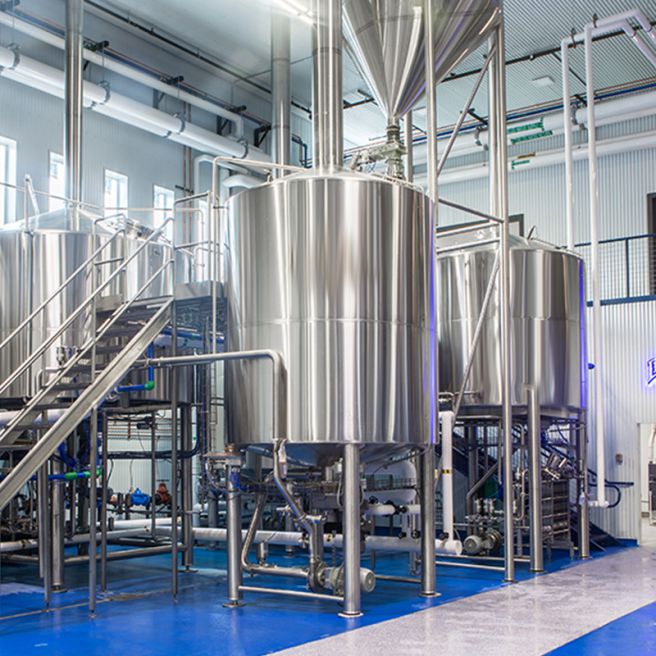
A quality brewhouse should use 304 or 304L stainless steel for most wort-contact vessels, piping, frames, and fittings, with 316L used where chloride exposure or stronger cleaning chemistry requires higher corrosion resistance. Typical 304 contains about 18% chromium and 8% nickel, while 316L adds roughly 2–3% molybdenum. Product-contact surfaces should normally be finished to about Ra ≤ 0.8 μm, with smooth welds, drainable piping, food-grade seals, and insulation suited to operating temperature. Material thickness cannot be judged by one number; vessel diameter, pressure, heating method, reinforcement, and local pressure-equipment rules determine the required construction.
Stainless steel works well in a brewhouse because brewing combines hot water, wort, organic deposits, alkaline cleaners, acids, oxygen, and repeated heating and cooling. Chromium forms a thin passive oxide layer on the metal surface. Common 304 stainless contains roughly 18% chromium and 8% nickel, giving it good corrosion resistance without making fabrication unusually difficult. Alfa Laval’s 2024 pump handbook lists 304 as a widely used stainless grade for hygienic food and beverage applications.
That composition makes 304 or low-carbon 304L a sensible starting point for mash vessels, lauter tuns, kettles, whirlpools, hot-liquor tanks, many process pipes, platforms, and exterior panels. A brewery does not gain much by specifying 316L everywhere when the water contains little chloride and the cleaning program stays within the chemical limits provided by the equipment manufacturer.
316L becomes more useful when operating conditions are less forgiving. Molybdenum improves resistance to pitting and crevice corrosion in chloride-containing environments, while the lower carbon level of 316L improves its suitability around welded areas. Commercial 316-family stainless commonly contains about 16–18% chromium, 10–14% nickel, and 2–3% molybdenum, although the exact allowable chemistry depends on the governing material standard.
Temperature also changes the material choice. Alfa Laval gives one useful equipment-specific example for plate heat exchangers at pH 7.5: recommended chloride limits at 25°C are listed as 100 ppm for Alloy 304 and 1,000 ppm for Alloy 316; at 80°C, the listed values fall to 20 ppm and 100 ppm respectively. Those numbers are not universal brewhouse limits, but they show why water chemistry and temperature have to be considered together rather than treating “stainless steel” as one material.
| Part of the brewhouse | Common material approach | What should be checked |
|---|---|---|
| Wort-contact vessel | 304/304L; 316L where required | Surface finish, welds, thickness |
| Product piping | 304L or 316L | Internal finish, drainage, weld purge |
| Heat exchanger surfaces | Often 316L | Chloride level, temperature, chemistry |
| Exterior jacket | 304 or suitable stainless sheet | Sealing, washdown exposure |
| Gaskets | EPDM, FKM, silicone, PTFE where suitable | Temperature and chemical compatibility |
| Insulation | Mineral wool, polyurethane, or specified thermal material | Temperature rating and moisture control |
Surface condition deserves as much attention as alloy grade. 3-A Sanitary Standards guidance generally calls for product-contact surfaces to be equivalent to or smoother than 32 microinch Ra, approximately 0.8 μm Ra, and free from pits, folds, crevices, and similar imperfections that interfere with cleaning. A tank made from certified 316L can still be difficult to clean when welds are rough, nozzle transitions contain recesses, or polishing is inconsistent.
A material certificate tells you what alloy was purchased. It does not tell you whether the finished vessel has smooth welds, complete drainage, sanitary geometry, or an internal surface that can be cleaned repeatedly.
For that reason, polishing specifications should use a measurable roughness value rather than wording such as “sanitary polished” or “mirror polished.” Ra measures the average surface roughness, normally in micrometres or microinches. A visually bright surface may still contain grinding lines or localized defects, while a correctly finished Ra ≤ 0.8 μm surface may look less decorative but be more suitable for food and beverage processing.
Welding follows the same principle. TIG welding is widely used on stainless brewery vessels and sanitary piping because the process provides good control over a relatively small weld area. Product-side pipe welds also require suitable shielding and back purging. Poor gas coverage can leave heavy oxidation, commonly called heat tint, on the reverse side of a weld. Post-fabrication pickling or passivation may then be specified to remove contamination and support restoration of the passive surface.
Weld geometry matters during CIP. A raised internal bead, incomplete penetration, undercut, pinhole, or poorly blended nozzle can retain wort solids after the rest of the vessel looks clean. A brewery running several batches per week may put the same surface through hundreds of heating and chemical-cleaning cycles in a year, so small fabrication defects are repeatedly exposed to alkaline cleaner, acid, hot water, and oxygen.
Material thickness requires more engineering than many equipment comparisons suggest. A 3 mm shell is not automatically superior to a 2 mm shell, and a 4 mm shell is not automatically safer than either. Diameter, vessel height, liquid head, jacket pressure, vacuum conditions, agitation, support-leg geometry, nozzle loads, wind or seismic requirements, and applicable design codes all affect the finished structure.
This is especially important for steam-heated equipment. A kettle may operate close to atmospheric pressure on the product side while its steam jacket operates as a pressure-containing space. The jacket, welds, reinforcement, valves, gauges, and pressure relief equipment therefore need to suit the specified steam pressure. Equipment supplied in 2026 should also be checked against the pressure-equipment requirements that apply where the brewery will actually be installed rather than against the supplier’s domestic assumptions.
For buyers comparing craft beer equipment, the useful specification is not simply “304 stainless steel, 3 mm.” A stronger purchasing document separates the inner shell, outer jacket, heating jacket, bottom or top head, structural supports, process piping, fittings, and pressure-containing sections. It also states whether the stated thickness is nominal material thickness before forming or a minimum finished requirement.
Gaskets deserve similar attention because they contact both product and cleaning chemicals. EPDM is common in beverage plants and is often suitable for hot water, steam under specified conditions, dilute acids, and alkaline cleaning. FKM is selected where higher temperature or chemical resistance is needed, silicone covers a different range of temperature and flexibility requirements, and PTFE offers broad chemical resistance but behaves differently from an elastomer under compression.
A specification should therefore name the seal material rather than say “food-grade gasket.” It should also state applicable food-contact compliance, maximum process temperature, CIP temperature, chemical concentration, and replacement schedule. Even if a gasket costs well under 1% of the brewhouse purchase price, a swollen or chemically damaged seal can create leaks or a difficult-to-clean gap at a product connection.
Piping geometry has a similar effect on sanitation. Product pipe should drain predictably, welded joints should be internally smooth, and branches should avoid unnecessarily long stagnant sections. Sanitary clamp fittings are useful where components require frequent removal, while orbital or carefully executed manual welds reduce the number of removable joints in permanent lines.
Flow conditions during cleaning also matter. In a 2020 brewery CIP technical Q&A, Alfa Laval recommended a minimum cleaning velocity of 1.5 m/s for DN150 and DN200 pipelines, corresponding in its example to approximately 1,000 hl/h and 1,700 hl/h respectively. Smaller brewery lines require much lower absolute flow, but the engineering point remains the same: pipe diameter, pump capacity, cleaning velocity, and spray-device demand have to be sized as one system.
Insulation belongs in the material specification because mash vessels, hot-liquor tanks, and kettles spend long periods above ambient temperature. Mineral wool is often selected around hotter surfaces because of its temperature capability, while polyurethane systems can provide useful thermal performance in suitable temperature ranges. Insulation thickness depends on operating temperature, thermal conductivity, jacket construction, allowable outer-surface temperature, and energy targets rather than a universal millimetre value.
Moisture control is equally important. Chloride-containing wash water trapped beneath cladding can create a more aggressive local environment than an exposed, regularly dried surface. Stainless-steel producer Outokumpu notes that chloride, higher temperature, lower pH, deposits, and crevices can increase the likelihood of localized corrosion. For a brewery washed down throughout a 365-day operating year, poorly sealed cladding joints can therefore matter even though they never touch beer.
Heating surfaces need their own review. Steam jackets should have uniform contact with the vessel wall and be designed for the stated pressure; electric elements need suitable sheath materials and watt density; internal or external calandrias need accessible product paths and appropriate heat-transfer surfaces. Large heat flux through a small area can increase local fouling, so heating capacity cannot be evaluated only by total kilowatts.
A buyer can make the material review more precise by asking the supplier to provide:
-
stainless grade for every major product-contact component;
-
mill or material certificates when traceability is required;
-
internal surface-finish specification in Ra;
-
welding and weld-finishing procedure;
-
passivation or pickling method where specified;
-
inner-shell, jacket, and head thicknesses separately;
-
gasket and valve-seat materials;
-
insulation type and thickness;
-
design and test pressure for pressure-containing sections;
-
applicable fabrication, electrical, pressure, and sanitary standards.
Material traceability becomes more useful on mixed-alloy systems. If a brewhouse uses 304L vessels but 316L pump heads, heat-exchanger plates, valves, or selected piping, certificates allow the installed component to be matched to its specified alloy. The distinction matters because visual inspection cannot reliably separate polished 304L from polished 316L.
Exterior stainless also deserves a specification, although it does not need the same finish as the wort-contact side. Brushed 304 sheet is common for vessel jackets and control enclosures in indoor breweries. A coastal site, a brewery using aggressive chlorine-containing wash chemicals, or an installation with regular outdoor exposure may justify a more corrosion-resistant exterior material. The appropriate grade depends on exposure, not appearance.
Copper can still appear on traditional-looking brewhouses, but modern installations often use it as decorative cladding over a stainless process vessel. Copper transfers heat well, yet it requires different cleaning and maintenance practices and does not offer the same practical fabrication route as stainless for a modern sanitary process system. A decorative copper skin can provide the traditional appearance while leaving 100% of the wort-contact vessel surface in specified stainless steel.
The purchasing specification should finally connect alloy, finish, fabrication, and operating conditions. 304/304L is suitable for a large share of commercial brewing service, while 316L is better reserved for locations where chemistry, chloride exposure, temperature, or cleaning conditions justify it. An Ra value, weld standard, gasket specification, pressure rating, insulation requirement, and material certificate provide far more usable information than the phrase “high-quality stainless-steel brewhouse.”